Wonders of India • September 13, 2020
Taj Mahal - A brief history of the wonder built in the 17th century
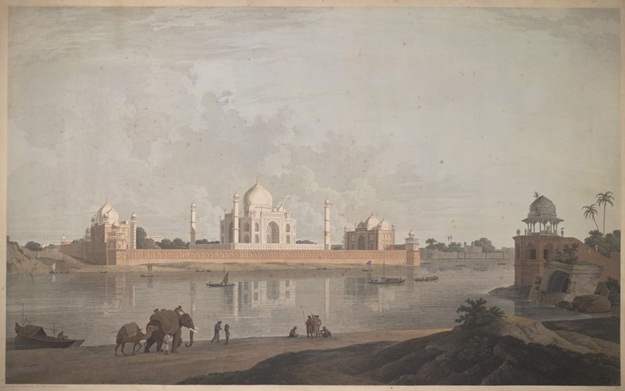
The Taj Mahal, which deservedly ranks amongst the finest tombs of the world, stands on the right bank of the Yamuna, about a mile below Agra Fort. It contains the remains of the Emperor Shah Jahan (1627-58) and of his favourite wife, Arjumand Bana Begam, better known as Mumtazu-z-Zamani or Mumtaz Mahal.
Mumtaz Mahal was the daughter of Abu-I-Hasan, and niece of the illustrious Mr Jahan, wife of the Emperor Jahangir (1605- 27). In her twentieth year she was married to Prince Khurram, afterwards, the Emperor Shah Jahan, on Friday 10th May,1612 AD and died on the 28th June 1631 AD after giving birth to her fourteenth child, Princess Gauharara, at Burhanpur in Khandesh.
She had accompanied her husband on his expedition against Khan Jahan Lodi, the rebellious governor of the Deccan. Her body was temporarily interred in the garden of Zainabad at Burhanpur. Whence, under the orders of Shah Jahan, it was brought to Agra after six months on 11th December 1631 AD by Prince Shuja" Wazir Khan and Satiu-N-Nisa Khanam, sister of the poet-laureate, Mirza Talib Almi.
In the meantime, a suitable site was selected which, being the garden of Rata Jai Singh of Jaipur, was duly exchanged for equally valuable State land, and her remains were again temporarily deposited near the present Baoli in a domed structure on 8th January 1632 AD until their permanent burial in the mortuary chamber of the Taj. The Emperor himself died on Monday,1st February 1666 AD and was buried in the same chamber to the west of Mumtaz Mahal's grave.
The question as to who designed the Taj is disputed, but there is epigraphical evidence to show that is was Usta Ahmad of Lahore. The mausoleum was constructed under the superintendence of Makramat Khan and Mir Abdu-l-Karim, the dome being built by Ismail Khan of Turkey and the inscriptions executed by `Abdu-I-Haq, better known as Amanat Khan of Shiraz, who was the brother of Shah Jahan's minister, Afzal Khan, and was the best calligraphist of his age.
The construction of the tomb was begun in 1631 AD and completed in 1648 AD with the mosque on the west, the Jawab or Mehman khana on the east and the main gateway on the south, the outer court and its cloisters being added subsequently and completed in 1653. The white marble so plentifully used, came from Makrana and Raiwala in Jaipur State, the red sandstone from Fatehpur Sikri and the neighbourhood of Agra, and the jewels and precious stones from Persia and elsewhere.
Original Source
This post is sourced from School of Indian History and can also be read on the source page.
Read the full article on School of Indian History